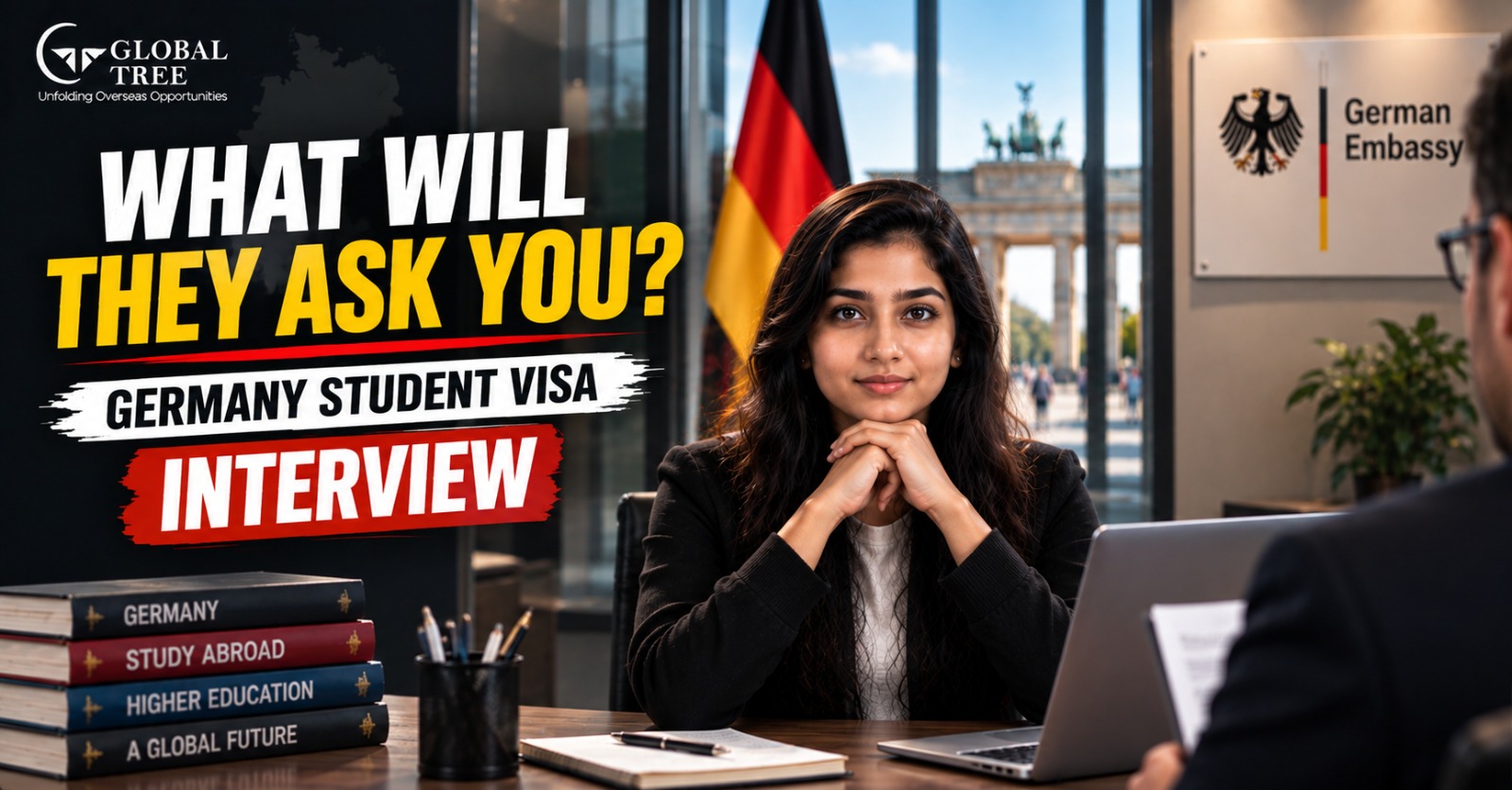
✅ Germany Student Visa Interview Questions and Answer Tips
- Introduction
- Understanding the Germany Student Visa Process
- Germany Student Visa Interview Questions You Should Prepare For
- How to Answer Germany Student Visa Interview Questions
- Germany Student Visa Documents to Know Before the Interview
- Germany Student Visa Interview for Indian Students
- What to Carry on the Day of the Visa Interview
- What Happens After the Germany Student Visa Interview?
- Germany Student Visa Interview Checklist
- Conclusion
- Frequently Asked Questions
Introduction
The interview for a German study visa allows the visa officer to understand your study intentions, academic credentials, financial preparations, and motivations for studying in Germany. The interview process for an international student who might be applying for the first time can become quite intimidating for him because he may not know which questions can come up at the interview and the amount of detail he will have to provide in his answers.
In the vast majority of cases, the main thing that the visa officer wants to check through this interview is the authenticity of your study intentions and that they correspond to the information presented in your application form. The topics he might want to talk about with you include your choice of the university and the course, your academic background, motivation for studying in Germany, financial resources, accommodation, and post-graduation plans.
It is advisable not to prepare yourself by learning some ready-made answers. On the contrary, you need to understand everything related to your application well and be able to explain your decision in detail.
Understanding the Germany Student Visa Process
Before going through a visa interview for Germany, it is crucial for students to comprehend the process of applying for the student visa. As an international student, they need to decide which type of visa suits them, then provide the necessary information and documentation, and undergo the right kind of appointment or verification process. It will depend on the situation of the applicant and where the visa application will be submitted.
1. National Visa for Long-Term Study
Students who intend to remain in Germany for purposes of further education for a period exceeding 90 days are expected to acquire a national visa, which is a type D visa, in place of a short-stay Schengen visa. The short-stay visa is a visa issued for temporary visits, whereas a national visa is meant for longer periods, such as studying at a university.
2. Consular Service Portal and Application Procedure
If the person applying comes from a certain place and situation, then the German Consular Services Portal can be used in the first stage of the application process. The person needs to fill out the right form and choose the right type of visa, giving their personal and educational details. Every detail must be exact, matching the information provided by the student in their documents.
3. Interview and Document Verification
The applicant must be ready to provide their original documents as well as any other documentation that is required by the German embassy. In the verification process, the official can ask questions regarding the course, institution, academic records, financial status, and study intentions. It is important to give responses that correspond to those in the application. Submission of all documents does not necessarily mean automatic approval since it is evaluated depending on the relevant requirements.
Germany Student Visa Interview Questions You Should Prepare For
Your interview for a Germany student visa usually centers around how genuine, research-based, and financially feasible your academic plans are. The officer conducting the interview is likely to ask some basic questions regarding your education, the institution, program, money, and plans. Rather than learning answers by heart, you need to be clear about why you chose something.
1. Questions About Your Academic Background
Be prepared to explain your previous education, subjects, academic performance, and how your background connects with the course you plan to study in Germany.
Possible questions include:
- What did you study previously?
- What was your academic performance?
- Why did you choose this particular field?
- How does your previous education relate to your chosen course?
- Why are you changing your field, if applicable?
2. Questions About Your University
It might be necessary for the interviewer to determine whether you have undertaken any serious research on the institution that you wish to join. Be aware of the institution's name, location, course format, etc.
Possible questions include:
- Which university have you been admitted to?
- Where is your university located?
- Why did you choose this university?
- How did you find this university?
- What attracted you to this institution?
3. Questions About Your Course
You should be able to justify what you will learn and how the program suits your objectives as a student. Do not give any answers that are too general and that would show that you joined the class without proper research.
Possible questions include:
- What is the name of your course?
- Why did you choose this program?
- What subjects or modules will you study?
- How long is the program?
- Why is this course relevant to your career plans?
- Why did you choose this course instead of a similar program elsewhere?
4. Questions About Choosing Germany
One can expect queries relating to the choice of Germany instead of other nations like India, where one could pursue studies. In your response, you need to provide valid reasons for your choice of Germany without justifying it based on its low cost and superior education facilities.
Possible questions include:
- Why do you want to study in Germany?
- Why did you choose Germany over other countries?
- What do you know about the German education system?
- Why do you think Germany is suitable for your field?
- Have you researched the city where you will study?
5. Questions About Your Finances
Financial readiness is one of the crucial elements for studying abroad. You should be prepared to justify how you will finance your studies and living expenses and comprehend the financial aspect of your application.
Possible questions include:
- Who is financing your education?
- How will you cover your living expenses in Germany?
- What are your estimated monthly expenses?
- Do you have a blocked account or another accepted form of financial proof?
- What does your sponsor do?
- How will your tuition and other educational expenses be paid?
6. Questions About Accommodation and Living Arrangements
During the interview, you may be asked about your accommodation plans, arrival arrangements, and how you intend to cover the cost of living in Germany.
Possible questions include:
- Where will you stay in Germany?
- Have you arranged accommodation?
- How far is your accommodation from the university?
- How will you travel to your university?
- What do you know about the city where you will live?
7. Questions About Your Future Plans
Inquiries regarding your plans after completion of your studies may give the immigration officer an idea about the purpose of your study and whether your plans are practical. Speak from your heart without giving a prepared answer.
Possible questions include:
- What do you plan to do after graduation?
- How will this degree help your career?
- Do you plan to work after completing your studies?
- What kind of career do you want to pursue?
- How does studying in Germany fit into your long-term plans?
8. Questions About Germany and Student Life
You may also get some basic questions to check if you have prepared yourself to live in Germany. You do not have to know everything about this country; however, you need to be aware of the practical matters of your relocation.
Possible questions include:
- What do you know about Germany?
- Which city will you live in?
- What language is commonly spoken there?
- Do you know anyone in Germany?
- How will you manage your daily life in a new country?
9. Questions About Your Application and Documents
The interviewer may ask questions depending on the information you provided. It is best to review your application prior to the interview to provide accurate information.
Possible questions include:
- When did you receive your university admission?
- What is your course start date?
- How did you meet the admission requirements?
- What are the details of your financial arrangements?
- Why is there a gap in your education, if applicable?
- Have you previously applied for a German visa?
10. Questions About Your Decision to Study Abroad
The interrogator could also pose more general questions in order to know your motives. Your answer should relate your educational experience, selected course, and objectives instead of using generalities.
Possible questions include:
- Why do you want to study abroad?
- Why not complete the same course in India?
- What do you expect to gain from studying in Germany?
- How will this international education contribute to your career?
How to Prepare Your Answers
Understanding will make the best preparation as opposed to memorization. Read your admission letter from the university, course information, your academic background, finance-related documents, your accommodation details, and all the application forms before attending the interview.
You must give accurate, appropriate, honest, and consistent answers. In case you don't understand what is being asked, it is advisable to request the interviewer to rephrase the question. The objective is not to give eloquent speeches but to show understanding of your studies and preparations to move to Germany.
[Read more: Planning to Study in Canada? Don't Miss These Visa Requirements]
How to Answer Germany Student Visa Interview Questions
A German student visa interview is not an assessment of your ability to remember memorized answers. The interviewer would like to know about your study intentions, educational history, financial preparations, and why you want to study in Germany. The ideal answers should be concise, factual, and in line with your application documents.
1. Answer the Question Directly
Answer according to the specific question the interviewer has asked; do not go into lengthy explanations that drift off from the subject matter.
For instance, when the interviewer asks you, "Why did you decide to attend this university?" focus on explaining your reasons for choosing this university rather than talking about Germany as a whole.
2. Explain Your Reasoning Clearly
Do not use vague statements like "Germany has good education." Mention what made you make this choice. For example, you can describe course design, subjects, opportunities for research, teaching methods, or relationships to your prior education and future career.
Your answer should be very specific because it sounds much more believable.
3. Connect Your Course With Your Background
Be prepared to explain why your chosen program makes sense based on your previous studies or professional experience. If you are changing fields, explain the reason logically.
Your answer should make the progression clear:
Previous education → Chosen course → Skills you want to develop → Future career direction
This helps the interviewer understand the purpose behind your study plan.
4. Know Your University and Course Details
You should feel at ease giving details about your university and program without having to consult your documents all the time.
Know details such as
- University name and location
- Course name and duration
- Major subjects or modules
- Course start date
- Admission requirements you fulfilled
- Reasons for selecting the program
- Relevant academic or career opportunities
You do not need to memorize the entire university website. Focus on information directly related to your decision.
5. Be Prepared to Discuss Your Finances
If the interviewer asks about money, be prepared to explain your source of funding to study abroad and how you plan to manage your expenses while living in Germany.
Know your:
- Source of funding
- Blocked account or other accepted financial arrangements, where applicable
- Expected living expenses
- Tuition or semester-related costs
- Sponsor details, if someone is supporting you
Avoid giving figures that contradict your documents.
6. Handle Questions About Germany Confidently
In case the interviewer asks you why you have chosen Germany, provide a personal and academic explanation and not one of those generic reasons.
You may say something about the German education system, about the particular program, about the research possibilities, or even about the value of the qualification in your future career.
The essential thing is to justify why Germany is the right choice for your own study plan.
7. Explain Your Future Plans Honestly
It may make some students uncomfortable to talk about their plans after graduation. You don't need to fabricate a response that you assume they want to hear.
Describe your real plans for your career and what part the qualification in Germany plays in them. If you have a specific industry, position, study path, or objective in mind, describe it.
8. Do Not Memorize Scripted Answers
Memorized responses may come across as being unnatural, particularly in situations where the interviewer poses a follow-up question. In such cases, one should plan with relevant ideas and rehearse how to articulate them in their own words.
For instance, recall three reasons you chose your university in place of memorizing a paragraph on why you enrolled at the university.
9. Stay Consistent With Your Documents
Your interview responses should not conflict with your application, admission letter, academic records, or financial documents.
Before the interview, review:
- University application details
- Admission letter
- Course information
- Academic history
- Financial documents
- Accommodation details
- Visa application information
If you notice an error or something has changed since submitting your application, understand how to explain it accurately rather than trying to hide it.
10. Stay Calm When You Do Not Know an Answer
Neither are you required to know everything about Germany and your university. If you don't know something for real, there's no need to make it up.
You may kindly say that you're not sure but still give all the information you have. In case you haven't understood the question, you may ask the interviewer to rephrase it.
11. Keep Your Answers Concise
An effective response does not necessarily have to be lengthy. It should provide adequate details needed for answering the question before ending. The interviewer can then follow up on it if he wants additional information.
A useful approach is
Answer → Brief explanation → Relevant example or detail
This keeps the conversation focused and makes your responses easier to understand.
12. Practice Follow-Up Questions
Do not prepare only for the obvious questions. Think about what the interviewer could ask after your initial answer.
For example:
Question: Why did you choose this course?
Follow-up: Why did you choose this university for that course?
Follow-up: How does the course relate to your previous studies?
Follow-up: What do you plan to do after completing it?
Practicing this type of conversation can make you more comfortable responding naturally instead of relying on memorized answers.
[Explore more: Nervous About Your F-1 Interview? Here's How to Prepare]
Germany Student Visa Documents to Know Before the Interview
Document preparation is not the only step that you need to take while preparing for a Germany student visa interview. The reason is that you need to know what information your document holds, as the visa officer can quiz you on any of the following things:
Your educational background, choice of university, financial status, and plans for study.
1. Passport and Identity Documents
Your passport will serve as proof of your identity and must be present during the entire visa process. Verify your personal information, along with all other information provided in your application, against that on your passport before going for the interview.
Do not forget to carry any photos or identification papers needed in the application process.
2. University Admission Letter
It will be among the most critical pieces of information that you should know before attending the interview. Do not simply carry it along with you; be well aware of the university name, course title, the location of the campus, the period of the course, intake, and start date.
The immigration officer can use this information to find out if you truly know the program you have selected.
3. Academic Certificates and Transcripts
Your past educational records provide evidence of your academic background. Check your certificates, mark sheets, transcripts, and other qualifying documents before the interview. Be ready to explain your academic performance and any changes in your field of study. If you have an educational gap, provide a clear explanation of your study gap experience and support it with appropriate documents.
4. APS Certificate
For several Indian students, the APS Certificate plays a significant role when applying to a German higher education institution. If it applies to you, be aware of the information attached to your APS certificate and make sure that your academic information matches the information on your visa application.
5. Language Proficiency Certificate
Be aware of the language used in your program and know the language qualification that you have provided. You may be asked questions related to your test, score, or proficiency level.
Avoid overstating your language skills in your interview response. Your answer needs to be based on your language qualification and proficiency in the program.
6. Proof of Financial Support
One needs to be able to explain in detail how one will manage to cover the costs during their time in Germany. Depending on various situations, it can be through a blocked account, scholarship, sponsorships, and many other forms of financial evidence.
Knowing where the funds come from, how much, and who will cover the expenses is necessary. If someone else will support your education, it needs to be clear who they are.
7. Motivation Letter
Reread your motivation letter before the interview because the officer can ask questions about the reasons why you chose Germany, your university, or your course of study.
Make sure that your verbal answers convey the same genuine reasons you mentioned in your application. You don't have to memorize the whole letter word for word. It is better to know the reasons behind your choices.
8. Curriculum Vitae
One of the key CV writing tips for studying abroad is to clearly highlight your educational background, work experience, internships, training, and other relevant experiences. Make sure all dates, qualifications, and other details are accurate and consistent. If you have changed your field of study, taken a break from education, or worked before applying for your chosen course, be prepared to explain these details during the admission or visa process.
9. Health Insurance Documents
Be sure to know about the insurance contract that you have taken for your stay in Germany. Be aware of the insurance provider, validity period, and date from which the insurance becomes effective.
If ever questioned regarding your insurance cover, you must be able to provide the basic information without going through any of your paperwork.
10. Accommodation Information
In case you have secured your accommodation, ensure that you have this information handy and you have all the basic information related to it, like where it is located, what kind of accommodation it is, and the expected cost.
If not, then be ready to justify how you will find your accommodation.
11. Previous Visa or Travel Documents
Wherever you have traveled abroad in the past, or if you have visas relevant to your application, you need to have those documents ready at hand.
However, the most important thing is that you should not forget what you mentioned about your past international travels. Your answer in the interview should match the application.
12. Keep Your Documents Organized
Organize your documents such that you can easily access them when you need to. Always have your original and duplicate documents in one place and don't carry loose documents that will make it hard to access the relevant information.
When preparing to go to the interview, double-check your documents against your application. This will be useful, but what is more important is knowing what they contain.
Germany Student Visa Interview for Indian Students
For Indian students applying to Germany, the student visa interview is not about memorising answers but about proving that your study plan is logical. Interviewers may want to know why you chose Germany, how your chosen course relates to your previous studies, how you plan to fund your education, and what you intend to do after graduating from a German university. A key part of interview preparation for a student visa is practicing answers to frequently asked questions. However, the best strategy is to understand the reasons behind each decision in your application rather than simply memorising responses.
1. Be Ready to Explain Your Academic Journey
Your academic background should form a coherent picture. Be ready to talk about your academic curriculum in India, your major courses, your academic results, and how this experience led to your choice of the selected program in Germany.
In case you have any breaks in your education, have switched specializations, or transferred from one academic discipline to another, do not be afraid to mention it. Make it clear how this experience led to your current academic program choice.
2. Know Why You Chose Your German University
Knowing the name of the university alone does not suffice. Reflect on why you have chosen the particular university.
You can talk about the format of the curriculum, topics covered, mode of instruction, research prospects, specialization options, or any other genuine reason that made you choose the university after careful analysis of your options.
3. Explain Your Course in Your Own Words
You should be able to provide a description of your course without necessarily referring to the official website of the university. You should know what you will learn, the duration of the course, your fields of interest, and the relevance of the qualification in relation to your past academic qualifications.
Even when your academic background is strong, an inability to give an account of what you will study makes your study plan less credible.
4. Have a Genuine Reason for Choosing Germany
The statement “Germany has good universities” is too general to justify your choice of a specific program. Germany can be considered among the best European countries to study abroad based on factors such as the quality of its academic programs and how well they align with your chosen specialization.
Your reasons could relate to the program structure, opportunities within your specialization, learning environment, or the relevance of the qualification to your future career. Most importantly, your reasons should genuinely reflect why you chose the program and Germany.
5. Understand Your Financial Plan
Don't look at your financial papers as something written for you by somebody else. Understand the way your study and living costs will be organized.
In case your parents finance your education, understand where your parents earn money and what their part is in financing your studies. In case you use the blocked account or the scholarship, understand all the particulars. The numbers and the explanations you will give must correspond to your application.
6. Prepare for Questions About Your Study Gap
Study gaps aren't necessarily a cause for concern, but a mysterious one might create more queries. If your time during this gap was occupied by work, exam preparation, training, personal issues, or something else, mention it. It's important to be direct in your explanation. It makes no sense to invent an unnecessarily complex tale of what happened during that period.
7. Understand Your APS-Related Details
Indian candidates are expected to know about the APS document in relation to their own case. The academic information that is related to your APS procedure should tally with the documents used for your admission and visa application at the university.
In case the interviewer inquires about your academic qualifications, you are supposed to answer without getting confused with dates and institutions of qualifications.
8. Be Comfortable Discussing Your Language Preparation
Be aware of the language of instruction in your program, as well as the required level of language proficiency. If your classes are taught in English, be prepared to communicate comfortably in English. Assess your level of German proficiency and consider learning the German language if it is relevant to your studies or daily life in Germany.
Your ability to communicate should reflect the level of language preparation you have mentioned.
9. Know Where You Will Live
You need to know realistically about your accommodation arrangement in Germany. If you have found a place to stay, know all the facts regarding the same. If you are still trying to arrange for the same, make sure you know about your plan in this regard.
In addition, you might be asked about how you will be commuting from your accommodation to the university.
10. Be Clear About Your Career Direction
Your program must relate to your future career aspirations. You don't have to outline your whole career path, but you need to have a decent understanding of the skills you want to learn and the destination they would lead you to.
If your career aspirations are being shaped now, be honest about that, yet explain in which direction you think.
11. Do Not Panic When the Officer Asks Unexpected Questions
Even if you prepare twenty questions that are commonly asked, you will still be surprised by some things. This is natural.
Rather than trying to give a good answer immediately, listen to the question and, after thinking for a moment, give an answer based on your own situation. If you don't understand what the officer wants to ask, ask for clarification.
12. Keep Your Answers Short and Personal
Longer answers do not necessarily make your interview answers better. Give the critical points first, and add any further details only if it is necessary.
Above all, do not make yourself sound like you copied answers from somewhere else. Your education, choice of college, finances, and future goals are your personal matters.
What to Carry on the Day of the Visa Interview
Use this checklist to make sure you have everything you may need before leaving for your Germany student visa interview.
Germany Student Visa Interview Checklist
- ☐ Valid passport and any required previous passports
- ☐ Completed visa application and appointment confirmation
- ☐ University admission letter
- ☐ APS Certificate, if applicable to your application
- ☐ Academic certificates and mark sheets
- ☐ Academic transcripts
- ☐ Language proficiency certificate, if required
- ☐ Proof of financial resources, such as the relevant blocked account or accepted funding evidence
- ☐ Scholarship confirmation, if you are receiving a scholarship
- ☐ Health insurance documents
- ☐ Curriculum Vitae (CV)
- ☐ Motivation letter or statement of purpose
- ☐ Proof of accommodation, if already arranged
- ☐ Tuition fee or payment evidence, where applicable
- ☐ Passport-size photographs meeting the required specifications
- ☐ Copies of important documents, arranged in an easy-to-find order
- ☐ Original documents, wherever required for verification
- ☐ Any additional documents specifically requested by the German mission
- ☐ A pen for completing or signing anything required at the appointment
- ☐ Contact details of your university and accommodation
- ☐ Emergency contact information
Before Leaving for the Appointment
- ☐ Check that your name, dates, university details, and other key information are consistent across your documents.
- ☐ Review your application so you can confidently explain the information you submitted.
- ☐ Keep documents arranged in a logical order rather than carrying loose papers.
- ☐ Check the appointment instructions for security restrictions and permitted items.
- ☐ Plan your journey so you can arrive with sufficient time before the appointment.
- ☐ Avoid carrying unnecessary electronic devices or restricted items if the visa center or mission does not permit them.
[Learn more: How Can You Make a Strong Impression in a Visa Interview?]
What Happens After the Germany Student Visa Interview?
The visa interview need not be the end of the Germany student visa process. Once the interview has been completed, the application is then reviewed by the concerned authority together with all the information that has been submitted through the process. There may be many considerations that will determine the result.
1. Application Processing
Following the interview, the application process undergoes the necessary review. The authorities may consider such issues as your admission information, academic record, finances, insurance coverage, and other relevant information.
During this stage:
- Your application is reviewed: The authorities assess the information and documents you submitted as part of your visa application.
- Documents may be verified: Academic certificates, financial evidence, admission information, or other documents may be checked when necessary.
- Additional information may be requested: If something requires clarification or further evidence, you may be asked to provide additional documents or information.
- Processing can take time: The timeframe is not identical for every applicant. It can depend on the application, verification requirements, and the responsible authorities.
- Keep your contact details active: Check your email, phone, and other communication channels used in your application so you do not miss an important request.
2. Visa Decision
After the necessary checks are done, a decision on the visa application is made. It could be an approval or rejection, based on whether all the requirements are fulfilled or not.
Keep in mind:
- A complete application does not automatically mean approval: Providing all requested documents is important, but the authorities still assess the application as a whole.
- Follow-up requests should be handled promptly: If the authorities ask for additional information, provide the requested material within the specified timeframe.
- Do not make unnecessary assumptions while waiting: Processing times can vary, so avoid treating online discussions or other applicants' timelines as a guarantee for your own case.
- Follow official communication: If you receive instructions from the responsible German mission or visa service, follow those instructions rather than relying on informal advice.
- Check the decision carefully: If your visa is approved, review the visa details when you receive your passport and ensure the information is correct.
3. If the Visa Is Approved
After getting the visa, you will need to go ahead with the preparation for studies in Germany. You should finalize all travel-related information, accommodation facilities, the university admission process, insurance coverage, and so on before leaving for Germany.
4. If the Visa Is Refused
It must be noted that a rejection does not imply automatic rejection in the future. Nevertheless, the students need to know why this happened in order to know what to do next, if it is still possible.
[Discover more: 17 Must-Know Questions for Your Canada Student Visa Interview]
Germany Student Visa Interview Checklist
🟢 ✓ Valid passport
🟢 ✓ Visa application and appointment confirmation
🟢 ✓ University admission letter
🟢 ✓ APS Certificate, if applicable
🟢 ✓ Academic certificates and mark sheets
🟢 ✓ Academic transcripts
🟢 ✓ Language proficiency certificate, if required
🟢 ✓ Proof of financial resources
🟢 ✓ Scholarship confirmation, if applicable
🟢 ✓ Health insurance documents
🟢 ✓ Updated CV
🟢 ✓ Motivation letter or Statement of Purpose
🟢 ✓ Accommodation details, if arranged
🟢 ✓ Tuition fee or payment proof, where applicable
🟢 ✓ Required passport-size photographs
🟢 ✓ Original documents for verification
🟢 ✓ Required photocopies of supporting documents
🟢 ✓ Any additional documents requested by the German authorities
🟢 ✓ University contact details
🟢 ✓ Emergency contact information
🟢 ✓ Appointment instructions and relevant confirmations
Conclusion
The process of a German student visa interview becomes a lot more straightforward if you know your application rather than memorizing prepared answers. It is expected of you to be able to provide information on your education, courses, university, funding, language preparation, and plans openly and honestly. Prior to attending the interview, take some time to go through your paperwork and ensure that you have all the necessary copies of original documents. It is crucial for you to remain calm, listen attentively, and provide answers based only on the questions asked during the interview. Proper preparation does not consist of perfection but of showing your sincere intentions.
Frequently Asked Questions
1. Why do German student visa officers ask about your chosen course?
The officer wants to understand whether your study plan is genuine and well thought out. Be prepared to explain what you will study, why the subject interests you, and how it connects with your previous education or career plans. Avoid memorized answers and explain your choice naturally.
2. What should I say when asked, “Why Germany?”
Give a specific academic reason rather than simply saying Germany has good universities or is affordable. You could discuss the course structure, practical learning, research opportunities, or the relevance of the program to your career. Your answer should also show that you have considered why Germany fits your goals better than other destinations.
3. Can the interviewer ask about my university and course?
Yes, you should know the important details of your chosen program. Be familiar with the university's location, course duration, major subjects, start date, and degree structure. If you cannot explain basic information about a program you supposedly selected yourself, it can make your overall study plan appear poorly researched.
4. How should I explain a change in my field of study?
Explain the connection logically instead of trying to hide the change. For example, you can describe how your previous studies, internship, employment, or personal interest led you toward the new field. The important thing is to demonstrate that the decision was intentional and that you understand what the new program involves.
5. Will I be asked how I will finance my studies in Germany?
Financial planning is an important part of the student visa process because applicants need to demonstrate that they can support themselves during their studies. The German authorities accept specific forms of financial evidence, which can include a blocked account, scholarship, or qualifying sponsorship.
6. What if the officer asks about my career plans after graduation?
Give a realistic answer based on your education and professional goals. You can explain the type of career you want to pursue and how the German qualification will contribute to it. Avoid giving an answer that sounds rehearsed or making promises about a particular job or salary that you cannot support.
7. Can poor German language skills cause problems during the interview?
The impact depends on your course and the language in which it is taught. Students should be able to communicate sufficiently to explain their study plans and understand the interview questions. For a German-taught program, demonstrating the required language preparation is particularly important, while an English-taught course may have different language expectations.
8. What questions can be asked about my previous education?
You may need to explain your previous qualifications, major subjects, graduation year, academic performance, and how your background relates to the proposed program. If you have changed fields, had a study gap, or experienced weaker grades, prepare a straightforward explanation. Keep your response factual rather than becoming defensive about your academic history.
9. Should I memorize answers before my Germany visa interview?
Memorizing complete answers is usually a poor strategy because an officer can ask the same topic in a different way. Instead, prepare key facts about your university, course, finances, previous education, and career plans. Practice explaining these points in your own words so your responses remain clear and consistent.
10. What documents should I know well before the interview?
You should understand the information contained in your admission letter, academic records, financial documents, insurance paperwork, and other documents submitted with your application. The German Foreign Office states that applicants need evidence of university admission and sufficient financial resources for their studies.
11. What should I do if I do not understand an interview question?
Do not guess or give an unrelated answer simply because you feel nervous. Politely ask the interviewer to repeat or rephrase the question, then respond as clearly as possible. Taking a few seconds to understand the question is better than giving an inaccurate answer that creates confusion about your study plans.
12. What is the best way to prepare for a Germany student visa interview?
Build your preparation around five areas: your course, university, academic background, finances, and future plans. Review every document you submitted and make sure your answers are consistent with the information in your application. The aim is not to deliver perfect speeches but to demonstrate that you genuinely understand your decision to study in Germany.