✅ Interview Questions for Freshers and How to Answer Them
Introduction
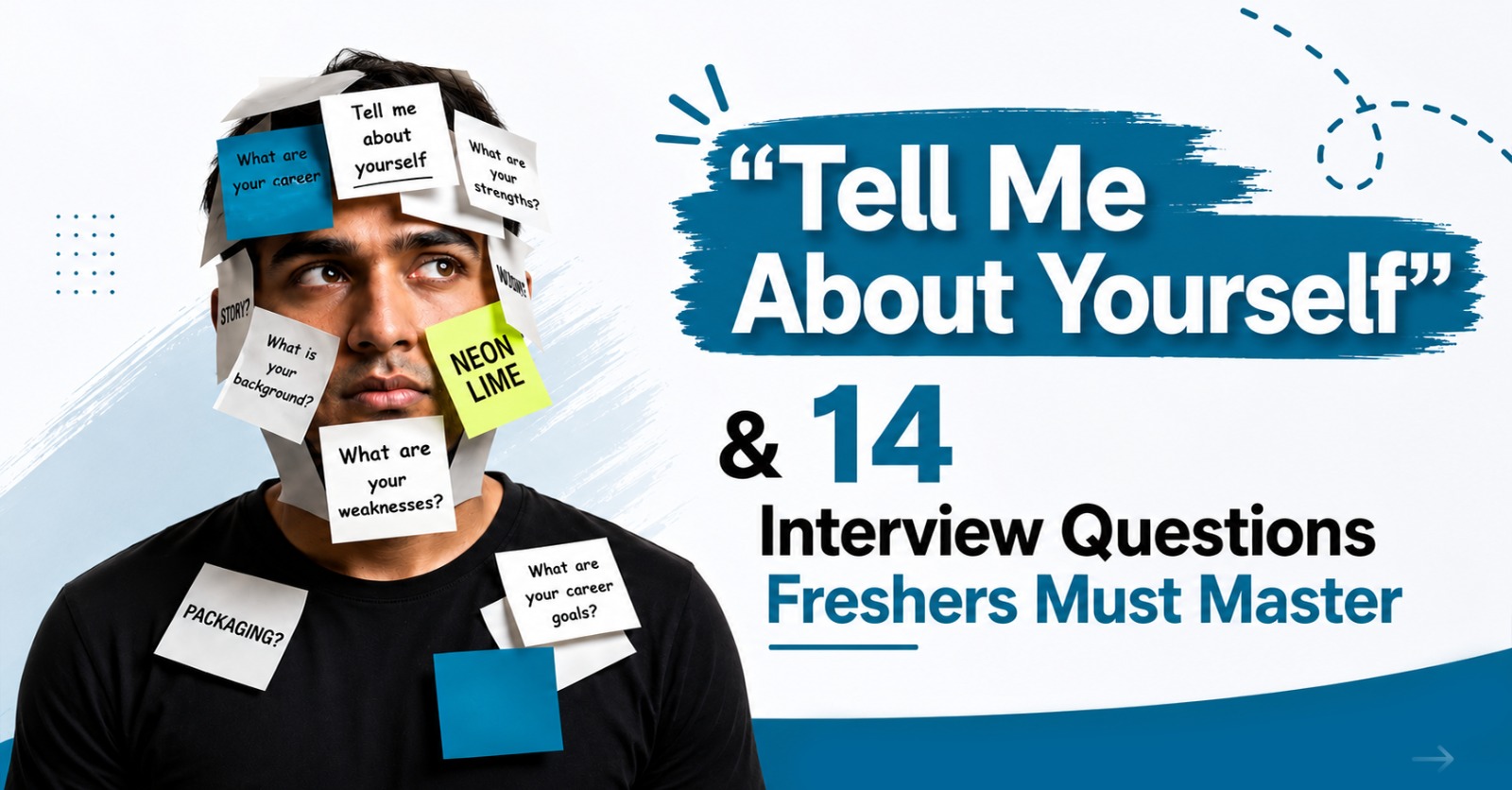
The experience of attending an interview for the first time is quite different from attending examinations at college since the recruiters are not interested only in the knowledge that you have learned. They would like to see your communication skills, confidence level, problem-solving skills, attitude and willingness to learn. Rather than concentrating on giving the right answers, concentrate on knowing yourself well.
What Do Interviewers Look for in Freshers?
Freshers may lack extensive experience, but employers often value their potential, attitude, basic knowledge, and ability to demonstrate soft skills in the workplace. A good candidate should also be able to demonstrate a clear understanding of the job role, show a willingness to learn, and explain how their skills can contribute to the organisation.
-
Basic Knowledge Related to the Role
The interviewers would like to know if you are aware of the basic requirements of the job that you have applied for. They can ask any question regarding your course, project, technical knowledge, and the job responsibilities as per the job description. You need not know everything, but you must know the concepts you have learned.
-
Communication Skills
Communication skills are very important in nearly all workplaces. The interviewers will evaluate the way you communicate your ideas, answer questions, and interact. Communication skills do not involve speaking in a sophisticated language. They require you to speak your mind confidently and professionally.
-
Problem-Solving Ability
Fresh graduates may not be familiar with every tool or procedure used in the workplace, but their willingness to learn and demonstrate problem-solving abilities valued by employers can help them adapt and succeed. Being curious, asking questions, exploring new approaches, and showing how you have learned independently can further demonstrate your readiness to grow.
-
Willingness to Learn
Fresh graduates may not have experience with every tool or process used by an employer. What matters is whether they are willing to learn. Showing curiosity, asking relevant questions, exploring new technologies, and explaining how you have learned something independently can demonstrate that you are prepared to develop professionally.
-
Confidence and Professionalism
Confidence will allow you to talk about yourself without showing hesitation, and professionalism is your attitude towards this situation. It is necessary to remain cool, listen attentively to the questions, not interrupt, and talk frankly about your advantages and disadvantages. Confidence needs to be based on your preparation.
-
Teamwork
Most jobs involve working with other people, so recruiters look for qualities that contribute to effective teamwork. They may ask about group projects, college activities, internships, or situations where you worked with people who had different opinions. Be prepared to explain how you contributed, handled disagreements, and supported the team in achieving its goals.
-
Adaptability
The work environment can comprise shifting priorities, new technology, new tasks, and even unexpected conditions. As a result, employers appreciate freshers who are able to adapt to changes in their environment. You can showcase your adaptability through examples of fast learning of new skills, undertaking new assignments, managing changes in your college assignments, or adjusting based on feedback.
-
Attitude Toward Feedback
The recruiters also ask whether a fresher will be able to take constructive feedback and improve on it. Do not paint yourself in such a manner that you have no flaws. You need to talk about how you react when someone who has been teaching you or guiding you in a particular assignment finds a flaw in you that you need to work on.
-
Genuine Interest in the Position
There is no fooling around in a recruiting interview. The interviewer can easily tell if you have applied without knowing the job description. It is important for you to do research regarding the company and then apply to the role as per the job description. You should also talk about why you are interested in the role and how the role fits into your career plans.
-
Academic and Project Experience
Projects, internships, certificates, contests, volunteering, and extracurricular activities can be helpful for freshers as they help prove their practical skills. You should be ready to speak about the project you worked on, its purpose, your duties there, the problems you encountered, and what you learned from this experience. Even the smallest project can serve as an excellent example in your interview if you know how to demonstrate your contribution in it.
-
Honesty and Self-Awareness
Some freshers think they need to provide the “perfect” answer. However, sincerity is often better. If you do not know something, be honest about it and explain how you would learn or find the answer. Being able to identify your strengths and weaknesses in an interview shows self-awareness. Overall, recruiters are often looking for potential rather than perfection in fresh graduates. Strong preparation, basic knowledge of the role, clear communication, a willingness to learn, and a professional attitude can help you make a positive impression despite limited work experience.
Common Interview Questions for Freshers
Some questions posed to freshers include those that will help the interviewer get insight into your background, motives for applying for the job, communication skills, and work methodology. You are not required to give specific answers by heart; rather, you must try to find out what the interviewer wants from you and get ready with some examples based on your academic project or internship experience or any certification from college.
1. Tell Me About Yourself
When the interviewer asks you, "Tell us something about yourself," he wants to know something about you as a professional, something about your education and skills and your motive in applying for that particular job.
A simple structure is:
Present → Education → Experience/Projects → Skills → Career Interest
Example:
"I recently completed my Bachelor's degree in Computer Science, where I developed a strong interest in software development. During my final year, I worked on a web application project where I was responsible for developing the backend and testing the application. I have also completed a course in Python and have been improving my programming skills through personal projects. I am now looking for an entry-level software development role where I can apply what I have learned and continue developing my technical skills.
Avoid giving your entire life story, repeating everything already written on your resume, speaking for too long, or using a memorized introduction that sounds unnatural.
2. Why Should We Hire You?
This question gives you an opportunity to explain why your skills and attitude make you suitable for the position. As a fresher, you may not have extensive professional experience, so focus on your relevant knowledge, projects, willingness to learn, and personal skills that improve employability, such as communication, adaptability, and teamwork. Connect these strengths directly to the job requirements and support your claims with relevant examples.
Example:
"I believe you should consider me for this role because I have a good foundation in Java and SQL, which are mentioned in the job description. During my final-year project, I worked with a small team to develop a database-driven application, where I was responsible for writing queries and testing the system. I am also comfortable learning new technologies, and I am looking forward to developing my skills further in a professional environment."
Avoid saying "You should hire me because I am hardworking" without explaining how you have demonstrated it.
3. Why Do You Want to Work With Our Company?
It is an attempt by interviewers to determine if you've made an effort to learn about the company and whether your interest in the job is real. Before attending the interview, gather information on the firm's products or services, corporate culture, recent activities, and duties for the position.
Example:
"I am interested in your company because of its work in developing digital solutions for businesses. I was particularly interested in this position because it would allow me to work with technologies I have studied while gaining experience on real-world projects. I also noticed that the company provides opportunities for fresh graduates to learn from experienced teams, which is important to me at this stage of my career."
Avoid giving generic answers such as "Your company is very reputed, and I want to grow with your organization." Explain what specifically attracted you to the company.
4. What Are Your Strengths?
Choose two or three strengths that are relevant to the position rather than listing every positive quality you can think of. More importantly, support each strength with a real example that shows how you have demonstrated it.
Example:
"One of my strengths is problem-solving. During my final-year project, we faced an issue where the application was producing incorrect results for certain inputs. I reviewed the logic, tested different cases, and eventually identified an error in the validation process. I corrected it and tested the application again. I believe this experience improved my ability to approach problems systematically."
For a marketing position, another candidate might say:
"One of my strengths is creativity. During a college event, I was responsible for promoting the event on social media. I suggested using short video content instead of only static posts, which helped us attract more student interest."
Avoid exaggerated claims such as "I am the best problem-solver" or mentioning strengths that you cannot demonstrate with examples.
5. What Is Your Biggest Weakness?
It’s rare for interviewers to seek perfection in your answer. What they actually hope to find is if you’re aware of yourself and if you make efforts to improve yourself. It is okay to admit any weakness, provided that you are taking active steps to overcome it.
Example:
"Earlier, I sometimes spent too much time trying to make my assignments perfect before considering them complete. During group projects, I realized that this could affect deadlines. I have started prioritizing tasks based on importance and setting time limits for individual activities. This has helped me become more efficient."
Another example:
"I used to feel nervous when speaking in front of a large group. To improve, I started participating more actively in college presentations and group discussions. I am now much more comfortable explaining my ideas in front of others."
Avoid saying "I have no weaknesses" or using overly rehearsed answers such as "My weakness is that I work too hard."
[Discover more: Top Strengths and Weaknesses to Mention in an Interview]
6. Where Do You See Yourself in Five Years?
Your interviewer is interested in knowing if you have reasonable expectations for your career and if the job suits your overall career goals. Since you are a fresher, you don’t have to guess what title you will be holding after five years. What matters is the skill set and the experiences that you want to gain.
Example:
"Over the next five years, I would like to build strong expertise in software development and become capable of handling projects with greater independence. I hope to take on more complex responsibilities as I gain experience and eventually contribute to technical decisions within my team. At this stage, my priority is to build a strong foundation and continue learning."
Avoid saying that you expect to become the CEO within five years or giving an answer that suggests you have no interest in developing within the organization.
7. Why Did You Choose Your Degree or Field?
This question helps interviewers understand your academic interests and whether your educational background connects with your career plans. Give an honest explanation and mention experiences that influenced your decision.
Example:
"I chose computer science because I was interested in understanding how software and technology solve practical problems. During my degree, I particularly enjoyed programming and database-related subjects. My final-year project gave me an opportunity to apply those concepts to a real problem, which confirmed my interest in pursuing a career in software development."
If your degree is not directly related to the job, you can explain how your transferable skills connect with the position.
Example:
"I studied commerce, but during college I developed an interest in digital marketing through a student organization. I started learning about social media and content marketing independently and later completed a certification. That experience made me interested in building a career in digital marketing."
8. What Are Your Career Goals?
When answering questions about career goals, show that you have direction while remaining open to learning and changing as you gain experience. Understanding the importance of setting career goals can help freshers define realistic ambitions without feeling pressured to plan every stage of their career. You can structure your answer around short- and long-term goals.
Example:
"In the short term, I want to gain practical experience and strengthen my technical skills by working on real projects. I also want to understand how professional teams work and learn from experienced colleagues. In the long term, I would like to become a specialist in my field and take on responsibilities that involve leading projects or mentoring junior team members. I am also open to exploring new areas as I gain experience."
For a marketing graduate:
"My short-term goal is to develop practical experience in digital marketing, particularly in content and performance marketing. Over time, I aim to manage campaigns independently and eventually take responsibility for larger marketing strategies. I am open to learning different areas of marketing before deciding where I want to specialize.
Avoid giving an answer focused only on salary, saying that you want to leave for another company as soon as possible, or presenting an extremely rigid five-year plan. As a fresher, learning, gaining experience, and staying adaptable are important parts of a strong career goal.
HR Interview Questions for Freshers
Most of the time, HR interviews are focused on assessing how you will react in various work environments. Since, as a fresher, you don't have much experience in the corporate environment, you can relate your actions through experiences from your college projects, internships, exams, co-curricular activities, volunteering or team projects.
1. How Do You Handle Pressure?
Interviewers want to know whether you can remain organized and productive when you have multiple responsibilities or tight deadlines. Instead of simply saying that you work well under pressure, explain how you manage it.
Example:
"During my final semester, I had to prepare for examinations while completing my final-year project. I listed the tasks that needed immediate attention, divided the project into smaller activities, and created a daily schedule. By following the plan consistently, I was able to complete the project on time while preparing for my exams."
This shows prioritization, planning, and time management rather than simply claiming that you can handle pressure.
2. How Do You Handle Failure?
A good answer should show that you take responsibility for setbacks instead of blaming other people. Explain what went wrong, what you learned, and what you changed afterward.
Example:
"During a college presentation, I was not able to explain one section of the project clearly because I had not prepared enough for possible questions. I realized that knowing the project was not enough; I also needed to practise explaining it. For later presentations, I prepared potential questions and practised my answers beforehand. This helped me become more confident."
The important part is to demonstrate learning and improvement, not to present yourself as someone who never makes mistakes.
3. How Do You Handle Criticism?
Recruiters want to see how well you handle constructive criticism without becoming defensive. Explain how you respond to feedback, apply it to your work, and develop your assertiveness when communicating your ideas.
Example:
“During a group project, my professor suggested that my presentation contained too much information and could be made more concise. Rather than taking the feedback personally, I reviewed the presentation and removed unnecessary content. I also started focusing more on the main message when preparing presentations. The feedback helped me communicate my ideas more clearly.”
This example shows self-awareness, openness to feedback, and a willingness to improve.
4. Are You Comfortable Working in a Team?
Most professions require people to work together as a team, so interviewers want to know whether you understand the importance of respectful communication when working towards a common goal. Give an example that clearly explains your role and how you contributed to the team.
Example:
“During my final-year project, our group had four members, and I was responsible for the technical implementation and testing. We divided the work based on our strengths and had regular discussions to track our progress. When one team member faced a problem, we worked together to find a solution. The experience taught me how effective communication and coordination can help a team work towards a common goal.”
5. How Do You Resolve Conflicts With Team Members?
Conflicts can occur when people have different opinions, working styles, or priorities. Emotional intelligence in professional settings can help you handle disagreements calmly and professionally without allowing conflicts to affect the team’s work.
Example:
"If I disagree with a team member, I first try to understand their perspective rather than immediately arguing against it. During a college project, another team member and I had different ideas about how to complete one part of the project. We discussed the advantages and disadvantages of both approaches and selected the option that best suited our deadline and project requirements. I believe it is better to focus on solving the problem rather than making the disagreement personal."
6. How Do You Prioritize Your Work?
This question tests your organization and time-management skills. Explain how you decide which tasks need immediate attention and how you manage larger assignments without leaving everything until the last minute.
Example:
"I usually begin by listing all the tasks I need to complete and identifying which ones are both urgent and important. If I have a project deadline approaching while also having smaller assignments, I divide the larger project into smaller tasks and schedule them across the available days. This helps me make steady progress while ensuring that urgent deadlines are not missed."
A useful approach is to consider deadlines, importance, dependencies, and the amount of time required for each task.
7. Are You Willing to Learn New Skills?
For freshers, employers understand that you will not know every tool or process used by the organization. They want to see whether you are curious, adaptable, and willing to develop skills for continuous learning as you grow into the role.
Example:
"Yes. During my degree, I became interested in data analysis even though it was not a major part of my coursework. I started learning Excel and basic Python through online resources and used them for a small academic project. I enjoy learning new skills when I see how they can be applied to practical problems, and I am comfortable learning new tools required for this role.
Whenever possible, support your answer with an actual example of self-learning or adapting to something unfamiliar.
8. How Would Your Classmates or Professors Describe You?
This question is an opportunity to discuss your personality and working style through the perspective of people who have worked with you. Choose two or three genuine qualities and support them with examples.
Example:
"I think my classmates would describe me as dependable and approachable. During group assignments, I usually made sure that my part was completed before the deadline so that other members could continue their work. My professor also appreciated that I was willing to help classmates understand concepts when they had difficulty with them. I believe these qualities have helped me work effectively with different people."
Avoid listing too many qualities without evidence. Two or three genuine qualities with examples are usually more convincing than a long list of positive words.
Technical Interview Questions for Freshers
The technical interview for freshers generally checks if you have a grasp of the basics of your domain and if you can use the knowledge that you gained in college in practical scenarios. Questions vary from one job profile, degree, and organization to another. Rather than learning thousands of answers by rote, you need to get the basics of the subject clear in your head.
Basic Technical Questions
Computer Science and IT
For Computer Science and IT freshers, interviewers commonly test fundamental technical knowledge and may ask you to explain concepts in simple terms or solve basic problems.
- Programming Fundamentals: Be prepared for questions on variables, data types, loops, functions, object-oriented programming, error handling, and basic programming logic. You may also be asked to write or explain a simple program in a language you have listed on your resume.
- Data Structures: Revise arrays, linked lists, stacks, queues, trees, graphs, searching, sorting, and basic algorithmic concepts. Interviewers may ask when a particular data structure would be useful and why you would choose it.
- Databases: Understand concepts such as tables, primary and foreign keys, relationships, normalization, SQL queries, joins, and basic database operations. You should be able to explain how you used a database if you have mentioned a database project.
- Operating Systems: Prepare topics such as processes, threads, memory management, file systems, scheduling, and basic operating system concepts. Questions may focus on understanding rather than advanced theoretical knowledge.
- Computer Networks: Revise concepts such as IP addresses, DNS, HTTP and HTTPS, TCP/IP, routers, switches, and basic network security. You should understand how data moves between systems at a basic level.
- Software Development Concepts: Be familiar with the software development life cycle, version control, testing, debugging, Agile methods, and basic development practices. If you have used Git or another development tool, be prepared to explain how you used it.
Engineering
Engineering interviews generally focus on core technical concepts, practical applications, and your ability to connect classroom learning with real-world problems.
- Core Engineering Concepts: Revise the fundamental subjects related to your specialization. For example, mechanical engineering candidates may be asked about thermodynamics or machine design, while electrical engineering candidates may need to explain circuits, electrical machines, or power systems.
- Practical Applications: Interviewers may ask how a theoretical concept is used in an actual product, machine, process, or workplace. Try to understand the practical purpose of the concepts you studied rather than memorizing definitions alone.
- Academic Projects: Be prepared to explain your project objective, your individual contribution, technologies or equipment used, challenges faced, and outcome. Interviewers may ask follow-up questions to determine whether you genuinely worked on the project.
- Industry-Related Fundamentals: Research the basic technologies and processes commonly used in the industry you are applying to. Understanding how your academic knowledge connects with the company's work can help you answer technical questions more confidently.
Finance
For finance freshers, technical questions often test accounting knowledge, financial concepts, numerical understanding, and familiarity with commonly used tools.
- Accounting Basics: Revise concepts such as assets, liabilities, revenue, expenses, profit, balance sheets, income statements, and cash flow statements. Be prepared to explain how these financial statements are connected.
- Financial Concepts: Understand basic concepts such as interest, inflation, investment, financial ratios, risk, return, and budgeting. Depending on the position, you may also face questions related to corporate finance or financial markets.
- Excel and Analytical Skills: Excel is widely used in finance-related roles, so revise formulas, functions, sorting, filtering, pivot tables, charts, and basic data analysis. If you have used Excel for an academic project, prepare to explain what you did.
Marketing
Marketing interviews usually assess whether you understand basic marketing principles and how businesses use them to understand customers and promote products or services.
- Marketing Fundamentals: Revise concepts such as target audiences, market segmentation, positioning, branding, the marketing mix, customer acquisition, and customer retention.
- Digital Marketing: Understand the basics of SEO, social media marketing, content marketing, email marketing, paid advertising, and digital analytics. You may be asked how you would promote a product or improve its online visibility.
- Consumer Behaviour: Learn how factors such as customer needs, preferences, pricing, brand perception, and purchasing behaviour influence marketing decisions. Interviewers may give you a situation and ask how you would approach a particular customer group.
- Market Research: Understand how businesses collect and analyze information about customers, competitors, and market trends. You may be asked about surveys, interviews, competitor analysis, customer feedback, or basic marketing metrics.
How to Prepare for Technical Questions
Rehearse your basic concepts related to your subject before going for the interview, and try to explain every concept using your own words. Also practice all the technical skills that are mentioned in your resume since an interviewer can ask you anything from your resume. But most importantly, try to grasp all the academic projects well since being able to explain your work and reasons behind your decisions will help you in your technical interview.
[Explore more: Professional Skill Development Courses for Career Success]
Situational Interview Questions for Freshers
Through situational questions, the interviewer is able to assess how you may react to certain situations in the office. As a fresher, you can give instances based on the work done during college projects, internships, assignments, examinations, and extracurricular activities. The point here is that your ability to think, communicate, and learn is emphasized.
What Would You Do If You Were Given a Task You Didn't Know How to Complete?
A good response should show that you do not panic or immediately depend on someone else to solve the problem. Start by understanding exactly what is expected, then break the task into smaller parts and identify what you already know and what you need to learn.
Example:
"First, I would make sure I clearly understand the task and the expected outcome. I would then research the topic using reliable resources and try to solve the problem independently. If I need clarification, I'll ask my team member or manager specific questions rather than saying I don't know how to do it. Once I understand the solution, I would apply it and make a note of what I learned so that I can handle similar tasks independently in the future."
This answer demonstrates problem-solving, initiative, research skills, and willingness to seek guidance when necessary.
What Would You Do If You Missed an Important Deadline?
The interviewers will want to understand if you accept responsibility for problems that arise. Do not try to shift blame onto other employees, poor instructions, or unusual circumstances if these factors are not really relevant to your explanation.
Example:
"If I realized that I was going to miss an important deadline, I would inform the concerned person as early as possible rather than waiting until the deadline had already passed. I would explain the reason for the delay, provide an updated completion time, and focus on completing the task as quickly as possible without compromising the quality. Afterward, I would review what caused the delay and adjust my planning so that the same problem does not happen again."
This demonstrates accountability, communication, time management, and learning from mistakes.
How Would You Handle Multiple Deadlines?
When several tasks have similar deadlines, the best approach is to avoid trying to complete everything at once. Time management strategies can help you prioritise tasks based on urgency and importance, then organise the work into manageable sections.
Example:
"I would first list all the tasks and their deadlines, then prioritize them based on urgency, importance, and the time required to complete each one. I would divide larger assignments into smaller tasks and create a schedule to make steady progress. If I realized that the workload could affect an important deadline, I would communicate this early with my manager or team and discuss priorities. This would help me manage the workload without compromising the quality of my work."
Interview Preparation Checklist for Freshers
Preparing for your first job interview can help you feel more confident and avoid last-minute mistakes. Use this checklist to make sure you are ready before the interview.
1. Research the Company
Learn about the company's products, services, industry, work culture, and recent activities. This will help you answer questions about why you want to join the organization.
2. Read the Job Description Carefully
Understand the responsibilities, required skills, qualifications, and expectations mentioned in the job description. Identify the skills you already have and areas where you may need to improve.
3. Review Your Resume
Go through your resume before the interview and be prepared to explain everything you have included. Interviewers may ask about your education, skills, projects, certifications, internships, or achievements.
4. Prepare Your Introduction
A good self-introduction in an interview should briefly cover your education, relevant skills, projects or experience, and explain why you are interested in the position.
5. Revise Relevant Technical Concepts
Review the fundamental concepts related to the role. Focus especially on subjects, tools, programming languages, software, or technical skills mentioned in the job description.
6. Prepare Project and Internship Examples
Be ready to explain your academic projects, internships, or practical experiences. Know your responsibilities, challenges, solutions, tools used, and what you learned from each experience.
7. Practise Common HR Questions
Practise questions such as "Why should we hire you?" "What are your strengths?" "What is your weakness?" "Why do you want this job?" and "Where do you see yourself in five years?" Focus on understanding your answers rather than memorizing them word for word.
8. Prepare Questions for the Interviewer
Prepare two or three thoughtful questions about the role, team, training, responsibilities, or growth opportunities. Asking relevant questions shows genuine interest in the position.
9. Choose Appropriate Interview Attire
Wear clean, neat, and professional clothing that suits the company and role. Avoid overly casual or distracting outfits, and make sure you feel comfortable and confident.
10. Check the Interview Location or Meeting Link
For an in-person interview, confirm the office address, travel route, parking or entry requirements, and expected arrival time. For an online interview, check the meeting link and platform beforehand.
11. Test Your Camera and Microphone
For online interviews, test your camera, microphone, speakers, internet connection, and lighting before the interview. Choose a quiet location with a clean and professional background.
12. Keep Important Documents Ready
Keep copies of your resume, certificates, portfolio, identification documents, and other requested materials available. For online interviews, have digital copies easily accessible.
13. Plan to Arrive Early
Try to reach the interview location around 10 to 15 minutes early. For online interviews, join a few minutes before the scheduled time so you can resolve any technical issues without rushing.
14. Stay Calm and Be Yourself
Good preparation is important, but you do not need to deliver perfect answers. Listen carefully, take a moment to think when necessary, and answer honestly. If you do not know something, acknowledge it professionally and explain how you would approach learning it.
[Learn more: What Recruiters Notice First in a Fresher's Profile]
Conclusion
Answering interview questions for freshers is not an exercise in finding a flawless response. Instead, it is an exercise that involves knowing about yourself, your abilities, your experiences, your career goals, and what the job demands so that you can articulate them in the best way possible. Practicing typical HR, technical, and situational questions could help.
Some tips for freshers include working on your basics, making yourself comfortable with your resume, having good examples of your internship projects and preparing well before appearing for your interview. With proper preparation and a positive attitude, fresh graduates could enter their first interview with confidence.